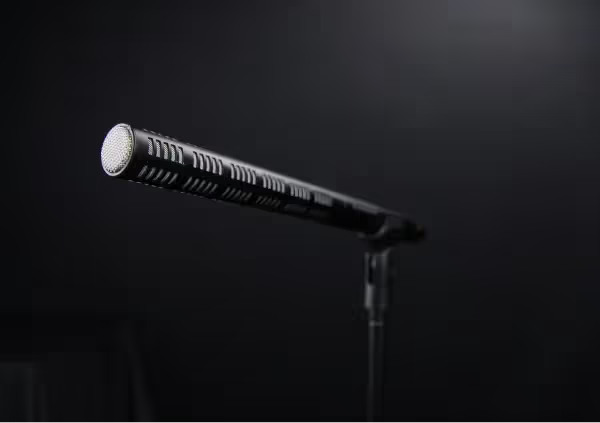
It may be worth reviewing how shotgun mics work. As the Sound on Sound website explains, “All shotgun mics employ a standard directional capsule — usually a supercardioid — but with a long, hollow, slotted ‘interference tube’ attached to its front surface.” and “The idea of the interference tube is that the wanted on-axis sound passes straight down the length of the tube to the capsule diaphragm unimpeded, but the unwanted off-axis sound has to reach the diaphragm by entering the side slots.” As Shure explains, “On-axis sounds share a uniform path length to the microphone capsule. Because they arrive at the same time, they end up being what we call “in phase” and are thus accepted by the mic element and passed down the audio circuit.”
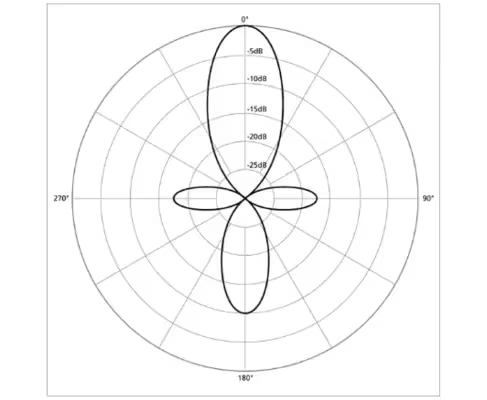
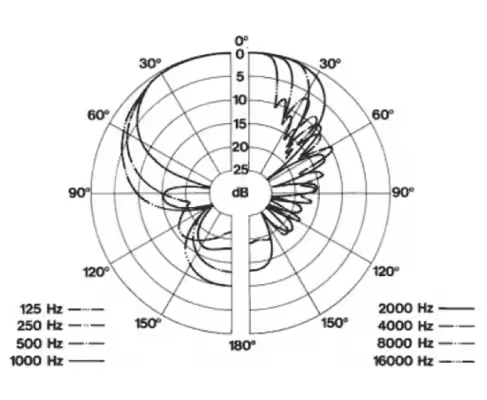
However, the interference tube has its own issues. As the Quora website states, “The design has drawbacks: different frequencies have different wavelengths, and therefore, each frequency is affected in a different magnitude. This causes “coloration” for off-axis sounds as components of the original waveform are attenuated differently according to frequency. This is unavoidable because of the principle of operation.” and “Take a look at the pickup pattern of a lobar microphone. all frequencies are equally represented at 0 degrees, but they are attenuated as you go off axis in differing amounts, resulting in coloration vs. the original sound spectrum.” (The referenced pickup pattern is shown on the right.)